

You were just in a crash, or someone you love was, and now you’re trying to make sense of it. Maybe your neck is sore and an adjuster has already called. That’s normal. Here’s the plain answer: the most common types of car accidents are rear-end collisions, angle crashes (which include T-bones), sideswipes and crashes into fixed objects such as trees and poles. Head-on collisions are rarer but among the deadliest. Rollovers, pileups, hit-and-runs, parking-lot crashes, and crashes involving trucks, motorcycles, people on foot and cyclists each raise their own questions. The type of crash matters because it points to who is usually at fault and what evidence proves it.
In 2023, police in the United States reported more than 6.1 million crashes. About 1.7 million of them injured someone, and 37,654 were fatal. Those numbers count crashes, not people: about 41,000 people died that year, and an estimated 2.4 million were injured, according to the National Highway Traffic Safety Administration (NHTSA). Michigan’s rules are in the boxes marked “In Michigan.”
Hurt and not sure where you stand? Get a free case review. Four quick questions, no cost, no obligation.
What are the most common types of car accidents?
NHTSA sorts crashes by the first event that caused an injury or damage and, when two vehicles on the road collide, by how they hit. In 2023:
| Type of crash, 2023 | All police-reported | Injury crashes | Fatal crashes |
|---|---|---|---|
| Rear-end | 1,748,481 | 461,282 | 2,701 |
| Angle (includes T-bone) | 1,393,852 | 498,210 | 7,044 |
| Sideswipe | 906,826 | 126,990 | 967 |
| Head-on | 174,842 | 87,363 | 4,230 |
| Hitting a fixed object, such as a tree, pole or ditch | 868,608 | 256,302 | 10,371 |
| Hitting a pedestrian | 69,041 | 60,848 | 6,777 |
| Hitting a cyclist | 56,244 | 49,361 | 1,145 |
| Rollover, when it’s the first event | 77,408 | 45,725 | 2,515 |
| All crashes | 6,138,359 | 1,697,252 | 37,654 |
Source: NHTSA, Traffic Safety Facts 2023, Table 29. Some categories, such as hitting a parked car or an animal, aren’t shown. What stands out:
- Rear-end collisions are the most common: an estimated 1.75 million, or 28.5% of all police-reported crashes.
- Angle crashes, the category that includes T-bones, are the most common kind of injury crash (29.4%) and made up 18.7% of all fatal crashes.
- Head-on collisions are rare but deadly: 2.8% of police-reported crashes but 11.2% of fatal crashes.
- Crashes into fixed objects, and rollovers, are deadlier than their numbers suggest. Collisions with fixed objects and noncollision crashes, such as rollovers, were only 16% of all crashes but 35% of fatal crashes.
Each crash is counted once, by its first event. A sideswipe that ends in a rollover counts as a sideswipe, so the table undercounts rollovers.
Does the type of crash decide who is at fault?
Not by itself, but it points to the questions that usually do. Fault usually turns on negligence: failing to use the care a reasonable person would use in the same situation (Cornell Law School’s Legal Information Institute, or Cornell LII). Breaking a traffic safety law without an excuse can count as negligence in itself, and traffic violations are the most common example (Cornell LII). So each type of crash has a usual suspect: the driver who hit someone from behind, ran a light, left their lane or turned across oncoming traffic.
Usual isn’t automatic. Fault can be shared, and in most states your share of the blame reduces what you recover rather than ending the claim: if you’re 20% at fault, you receive 80% of your damages. Many states bar recovery once your share reaches 50% or 51%, and only Alabama, Maryland, North Carolina, Virginia and Washington, D.C., can bar it for any fault at all (Cornell LII). See each state’s shared-fault rule. The other driver’s insurer will form its own view of what happened. That view is a negotiating position, not a finding, and the evidence you save early is what answers it.
Who is usually at fault in each type of crash?
Rear-end collisions
Usually the driver in back, because drivers are expected to leave enough room to stop. The driver in front can share the blame by stopping short for no reason, cutting in too close or driving with brake lights that don’t work. Car accidents are a common cause of neck pain, such as whiplash, a soft-tissue neck injury also called a neck sprain or strain (MedlinePlus, from the National Library of Medicine). A hit that makes the head and brain move quickly back and forth can also cause a concussion (CDC). More: who is at fault in a rear-end crash.
T-bone (side-impact) crashes
The front of one vehicle hits the side of another, forming a “T,” usually where paths cross. Fault usually comes down to who had the right of way. A driver who ran a red light or a stop sign, or turned left in front of oncoming traffic, broke a traffic rule, and that is strong evidence of fault. When both drivers claim the green light, witnesses, video and the cars’ event data recorders help decide it. Side impacts accounted for 22% of the deaths of people in cars, pickups, SUVs and vans in 2024, second only to frontal impacts (59%), according to the Insurance Institute for Highway Safety (IIHS). More: who had the right of way in a T-bone crash.
Sideswipes
In a sideswipe, the sides of both vehicles make only minimal contact, in NHTSA’s terms, as when one car moves into a lane another car already occupies. Most injure no one: of the 906,826 police-reported sideswipes in 2023, 86% caused only property damage, but 967 were fatal (NHTSA). The driver who left their lane usually bears the blame, because drivers must make sure a lane change is safe (in Michigan, MCL 257.642(1)(a)). Damage along both cars’ sides, dashcam video and witnesses help show who moved over.
Head-on collisions
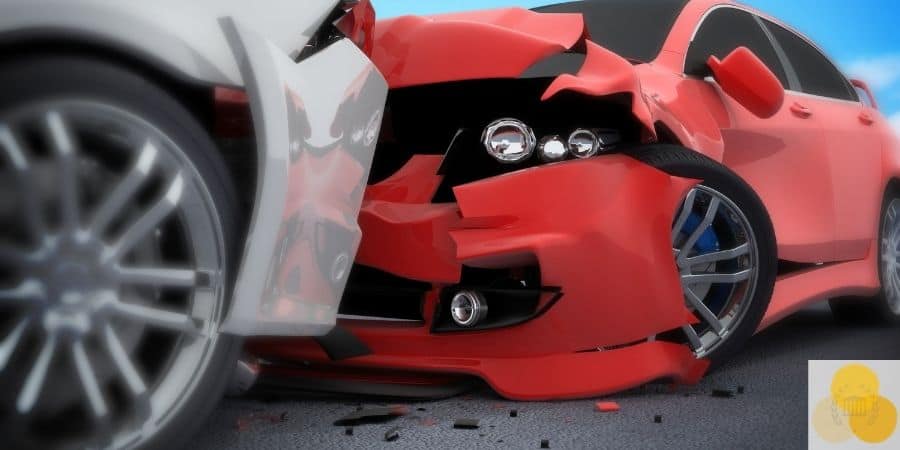
Of all crashes between two vehicles on the road, head-on collisions are the deadliest: about 1 in 41 was fatal in 2023, compared with about 1 in 163 of all crashes (NHTSA). Common reasons include a distracted, drowsy or impaired driver drifting over the center line, a driver going the wrong way and a pass on a two-lane road gone wrong. The driver who crossed into the other lane is usually at fault, but the proof, from gouge marks to the car’s event data recorder, can disappear within days. More: how to prove who crossed the line.
Single-vehicle and run-off-road crashes
More than half of fatal crashes involve only one vehicle: 56% in 2023, a count that includes one vehicle hitting a pedestrian or cyclist (NHTSA). Many are roadway departures: crashes that happen after a vehicle crosses an edge line or a center line, or otherwise leaves the traveled way. The Federal Highway Administration (FHWA) says they caused 51% of U.S. traffic deaths from 2016 to 2018, an average of 19,158 a year.
The driver who left the road isn’t always the only one at fault. Another driver may have forced them off without touching them, or a road defect or a failed tire may have played a part. If you were a passenger, your claim may be against your own driver’s liability insurance, which covers injuries a driver causes to others (National Association of Insurance Commissioners, or NAIC). See where else the money can come from, including road agencies and vehicle makers.
Rollovers
A rollover is a crash in which the vehicle tips onto its side or roof at any point. Many happen after a vehicle leaves the roadway, and a rollover can throw people out of the vehicle, which makes a death more likely (IIHS). Rollovers accounted for 28% of the deaths of people in passenger vehicles in 2024, 6,250 deaths in all, and pickups and SUVs are more likely than cars to be in fatal single-vehicle crashes, especially rollovers (IIHS).
Two questions matter: what set it off, such as another driver’s move or a road defect, and whether the vehicle protected the people inside. In a 1968 case, a federal appeals court held that a carmaker must use reasonable care in design to avoid “an unreasonable risk of injury in the event of a collision” (Larsen v. General Motors Corp.), so keep the vehicle until it’s been inspected. See how product liability claims work.
Pileups
In a chain-reaction crash, more than one driver can share the blame. The key questions are who hit whom, in what order, and whether each driver could have stopped in time. Vehicle damage, witnesses and event data recorders help answer them, and with several drivers come several insurers, each with its own view. More: who is at fault in a pileup.
Hit-and-runs
Report the crash to police right away, and write down whatever you can about the other car. If the driver is never found, your own coverage usually pays: uninsured motorist (UM) coverage, which pays if an uninsured or hit-and-run driver hits you, and medical payments coverage or personal injury protection (PIP) for your treatment (NAIC). Policies set their own conditions and deadlines for these claims, so read yours now. More: what to do after a hit-and-run.
Parking-lot crashes
Fault usually turns on ordinary care: which car was moving, whether a driver backing out made sure the way was clear, and whether someone cut across the lanes. Private property doesn’t excuse careless driving, but it can keep a crash out of the national numbers. NHTSA’s traffic-crash counts leave out crashes on private property not regularly used by the public, including some parts of parking lots and driveways, and NHTSA tracks these “nontraffic” crashes separately. More: who is at fault in a parking lot crash.
Truck crashes
In 2023, about 5,500 people were killed in traffic crashes involving large trucks, those rated over 10,000 pounds, and 70% of them were in other vehicles (NHTSA). More parties can share the blame than after a car crash: the driver, the trucking company, the owners of the truck and trailer, the company that loaded the cargo, a repair shop or a parts maker. Federal rules make trucking companies keep records that can show what went wrong, but some only for months: drivers’ logs of their hours for 6 months (49 CFR 395.8(k)). More: truck accident claims and how truck crash claims differ.
Motorcycle crashes
Riders have far less protection than people in cars. In 2024, 6,228 motorcyclists were killed and an estimated 86,887 were injured, and per mile traveled, motorcyclists died at almost 27 times the rate of passenger car occupants (NHTSA). In 45% of that year’s fatal two-vehicle crashes between a motorcycle and another type of vehicle, the other vehicle was turning left while the motorcycle went straight, passed or overtook (NHTSA). “I didn’t see him” doesn’t, by itself, excuse a driver who had to yield. More: motorcycle accident claims.
Pedestrian and bicycle crashes
In 2023, more than 7,300 pedestrians and nearly 1,200 cyclists were killed in traffic crashes, and an estimated 68,244 pedestrians and 49,989 cyclists were injured (NHTSA). Crashes in which a vehicle first struck a pedestrian were about 1% of police-reported crashes but 18% of fatal crashes. A pedestrian or cyclist can share the fault, for example by crossing against a signal, but in most states that reduces the claim rather than ending it. Your own auto policy may still help even though you weren’t in a car, so check its PIP, medical payments and uninsured motorist coverage. More: bicycle accident claims.
Not sure who was at fault in your crash, or whose insurance pays first? Get a free case review. Four quick questions, no cost, no obligation.
Who pays after a crash?
Who pays first depends more on your state than on the type of crash. In most states, the at-fault driver’s liability insurance pays for the injuries that driver causes. In the 12 no-fault states and Puerto Rico, including Michigan, your own personal injury protection (PIP) pays first, and you can usually sue for pain and suffering only if your injury passes a threshold (Insurance Information Institute, or Triple-I). Your own collision coverage, if you have it, pays for damage to your car from a collision with another car, an object or a pothole, or from flipping over, and uninsured and underinsured motorist coverage helps if the other driver had no insurance or not enough (NAIC). If someone died, the family may have a wrongful death claim.
What to do next
- Get medical care, even if you feel all right. Some concussion symptoms may not appear for hours or days (CDC).
- Save the evidence: photos of the damage, where the cars stopped, the road and the signals, plus witnesses’ names and any video, before it’s recorded over. Our checklist of 10 things to do after a car accident covers the first days.
- Tell your own insurer promptly and cooperate as your policy requires, in writing for Michigan PIP. You don’t have to give the other side’s insurer a recorded statement, and it’s safer not to before you’ve had advice. Don’t sign a release until you know how badly you’re hurt: signing one usually ends your claim.
- Read the guide for your type of crash, linked above, or browse all our car, truck and motorcycle accident guides.
- Get a free case review. Tell us what happened in four quick questions, at no cost. In Michigan, you can also compare injury lawyers near you. Get any fee agreement in writing; see how injury lawyers get paid.
What waiting can cost
- Evidence. Road marks fade, cars get repaired or scrapped, and video gets recorded over. Truck drivers’ logs only have to be kept for 6 months (49 CFR 395.8(k)).
- Proof of your injury. A long gap before treatment lets an insurer blame something else.
- Your right to sue. Every state sets a deadline to sue, called a statute of limitations, and notice deadlines can come much sooner.
What a good outcome looks like
The type of crash is recorded accurately, and the evidence for it is saved. Fault is split on that evidence, not on assumptions about what usually happens in that kind of crash. Your medical bills go to the right insurer and get paid while you heal, and whoever caused the crash pays fair compensation through their insurance. From guessing what kind of case a crash like yours makes to knowing who is likely at fault, who pays first and when your deadlines fall.
Frequently asked questions
What is the most common type of car accident?
Rear-end collisions. In 2023, police reported an estimated 1.75 million rear-end crashes, or 28.5% of all police-reported crashes, according to the National Highway Traffic Safety Administration (NHTSA). Angle crashes, the category that includes T-bones, were the most common kind of injury crash (29.4% of injury crashes).
What type of car accident is the deadliest?
It depends on how you count. Of all crashes between two vehicles on the road, head-on collisions are the deadliest: about 1 in 41 was fatal in 2023, compared with about 1 in 163 of all crashes. Crashes in which a vehicle first struck a pedestrian were fatal about 1 in 10 times (NHTSA). Counting deaths rather than crashes, the Federal Highway Administration says crashes after a vehicle leaves its lane or the road caused 51% of U.S. traffic deaths on average from 2016 to 2018.
How many people are injured in car accidents each year?
In 2023, about 41,000 people were killed in U.S. traffic crashes, by NHTSA's count, and an estimated 2.4 million more were injured. They were hurt in about 1.7 million injury crashes and 37,654 fatal crashes, out of more than 6.1 million police-reported crashes. The often-quoted figure of about 6 million is a count of crashes, and most of those crashes injured no one.
Does the type of crash decide who is at fault?
Not by itself. It points to the usual questions: who hit whom from behind, who had the right of way, who left their lane. Breaking a traffic safety law without an excuse can count as negligence in itself (Cornell LII), but fault can be shared, and in most states your share of the blame reduces what you recover rather than ending the claim. In Michigan, a jury that finds a driver broke a traffic statute may infer negligence unless the violation was excused (M Civ JI 12.01, 12.02).
Does the type of crash matter under Michigan's no-fault law?
Not for your PIP benefits, which your own insurer pays without regard to fault (MCL 500.3105(2)). The type of crash can decide which insurer pays: a motorcyclist hurt in a crash involving a car or truck claims PIP from that vehicle's owner's insurer first (MCL 500.3114(5)), and a pedestrian or cyclist with no household policy claims through the Michigan Assigned Claims Plan (MCL 500.3115). It also matters for a claim against the at-fault driver, where your damages are reduced by your share of fault and being more than 50% at fault bars pain-and-suffering damages (MCL 600.2959, 500.3135(2)(b)).
Sources
- Traffic Safety Facts 2023: A Compilation of Motor Vehicle Traffic Crash Data (DOT HS 813 738, August 2025), national statistics, Tables 28, 29 and 54, and glossary · National Highway Traffic Safety Administration
- Motorcycles: 2024 Data (Traffic Safety Facts, DOT HS 813 824, July 2026) · National Highway Traffic Safety Administration
- Large Trucks: 2023 Data (Traffic Safety Facts, DOT HS 813 717, April 2025) · National Highway Traffic Safety Administration
- 2020-2021 Non-Traffic Surveillance System Non-Crash Injuries Database User's Manual (DOT HS 813 470, April 2024) · National Highway Traffic Safety Administration
- Roadway Departure Safety (last updated August 25, 2023) · Federal Highway Administration
- Fatality Facts 2024: Passenger vehicle occupants (posted June 2026) · Insurance Institute for Highway Safety
- Neck Injuries and Disorders · MedlinePlus, U.S. National Library of Medicine
- About Mild TBI and Concussion · Centers for Disease Control and Prevention
- Symptoms of Mild TBI and Concussion (updated September 15, 2025) · Centers for Disease Control and Prevention
- Negligence (Wex legal dictionary) · Legal Information Institute, Cornell Law School
- Negligence per se (Wex legal dictionary) · Legal Information Institute, Cornell Law School
- Comparative negligence (Wex legal dictionary) · Legal Information Institute, Cornell Law School
- What Does Auto Insurance Cover? (June 11, 2026) · National Association of Insurance Commissioners
- Background on: No-fault auto insurance · Insurance Information Institute (Triple-I)
- 49 CFR 395.8, Driver's record of duty status (paragraph (k), retention) · Electronic Code of Federal Regulations
- Larsen v. General Motors Corp., 391 F.2d 495 (8th Cir. 1968) · Caselaw Access Project, Harvard Law School
- Michigan Model Civil Jury Instructions (updated July 21, 2026), M Civ JI 12.01 and 12.02 · Michigan Supreme Court
- Auto insurance frequently asked questions · Michigan Department of Insurance and Financial Services
- MCL 257.402, Rear-end collisions; prima facie evidence of negligence · Michigan Legislature
- MCL 257.642, Driving within a lane; changing lanes safely · Michigan Legislature
- MCL 257.650, Left turns at intersections · Michigan Legislature
- MCL 500.3105, PIP benefits payable without regard to fault · Michigan Legislature
- MCL 500.3107, Allowable expenses, work loss and replacement services · Michigan Legislature
- MCL 500.3107c, PIP medical coverage levels · Michigan Legislature
- MCL 500.3114, Order of priority for PIP claims, including motorcyclists · Michigan Legislature
- MCL 500.3115, PIP claims by people who were not in a vehicle · Michigan Legislature
- MCL 500.3135, Tort liability for noneconomic loss; serious impairment of body function; the mini-tort · Michigan Legislature
- MCL 500.3145, Limitations on actions for PIP benefits; notice of injury · Michigan Legislature
- MCL 500.3174, One-year notice to the Assigned Claims Plan · Michigan Legislature
- MCL 600.2959, Comparative fault; reduced damages · Michigan Legislature
- MCL 600.5805, Period of limitations for injuries to persons or property · Michigan Legislature
- MCL 600.6304, Allocation of fault when more than one person is at fault · Michigan Legislature
- MCL 691.1404, Notice of injury and defect in a highway · Michigan Legislature
- MCL 691.1411, Claims against government agencies; limitation of actions · Michigan Legislature
Updated September 25, 2026
This guide is general information, not legal advice, and laws change. For advice about your situation, talk to a lawyer licensed in your state. Reading this page or contacting us does not create an attorney-client relationship.