

You’ve just been in a car accident, or you’re helping someone who was, and you’re not sure what to do first. At the scene, get out of danger, call 911, trade information with the other driver and take photos. Within a day or two, see a doctor, even if you feel fine, and tell your insurance company. In the weeks after, get the crash report, keep a record of every cost, and don’t sign anything from the other driver’s insurer until you know how badly you’re hurt.
You’re not alone: U.S. police reported an estimated 6.18 million crashes in 2024, and an estimated 2.42 million people were injured (NHTSA). Rules vary by state, so Michigan’s are in the highlighted boxes.
Hurt and not sure where you stand? Get a free case review. Four quick questions, no cost, no obligation.
What should you do at the scene of a car accident?
Hit-and-run laws require drivers in a crash to stay at the scene and identify themselves, whoever caused it and however minor it seems (Cornell Law School’s Legal Information Institute). The details vary by state.
1. Stop, and get out of traffic if you safely can
Don’t drive away, even if the damage looks small or the other driver was clearly at fault. Turn on your hazard lights. If your car still drives normally and no one is badly hurt, move it out of the travel lanes; many states require this after minor crashes (Federal Highway Administration). The Michigan State Police advise that it’s then generally safest to stay in your car, seat belt buckled, until help arrives. If you get out, stand with the car between you and traffic.
2. Check for injuries and call 911
Check yourself and your passengers, then the people in the other car, and call 911 if anyone is hurt. Ask for the police even if the crash seems minor, since a police report is an official record of what happened. Some agencies don’t come to every crash, but you should still try to notify them (California Department of Insurance). Ask the officer when and where to get the report, and its number (National Association of Insurance Commissioners, or NAIC).
If the other driver takes off, note the plate and call the police right away: most auto policies require police notice within a set time after a hit-and-run (California Department of Insurance). See what to do after a hit-and-run crash.
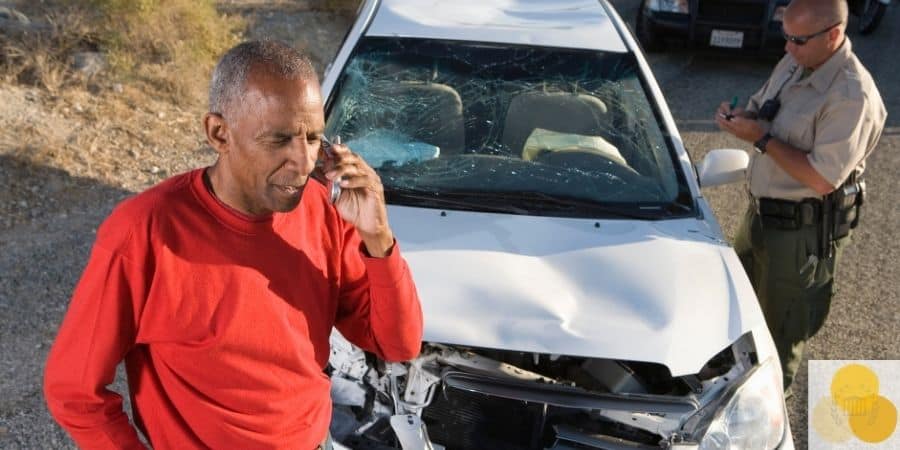
3. Exchange information, and help anyone who’s hurt
Get each driver’s:
- name, address and phone number
- driver’s license number
- license plate, and the car’s make, model and color
- insurance company and policy number
- the owner’s name and address, if the driver doesn’t own the car
A photo of the other driver’s insurance card and license makes this easy (Texas Department of Insurance). Give yours in return, and get passengers’ names and numbers. If someone is hurt, make sure help is on the way.
4. Photograph the scene and find witnesses
If you’re able, and only where you’re safe from traffic, photograph:
- every vehicle from several angles, and each license plate
- where the cars came to rest, if you can safely do it before they’re moved
- skid marks, debris, signals and signs, the road, the weather and the lighting
- your visible injuries, and again as they change
Get witnesses’ names and phone numbers (California Department of Insurance), since they may leave before the police arrive. Ask nearby businesses and homes about security cameras, and ask quickly, because video can be recorded over. Then write down what happened while it’s fresh.
5. Stick to the facts, and don’t admit fault
Answer the officer’s questions calmly and truthfully. If you don’t know something, such as the other car’s speed, say so instead of guessing. Don’t apologize or say the crash was your fault, even to be polite: you may not know everything that caused it, and fault is decided later, from the evidence. The California Department of Insurance advises saving your story for the police and your insurer, and not signing statements about fault. See how fault is decided in injury cases.
What should you do in the first 72 hours after a car accident?
6. See a doctor, even if you feel fine
Get checked within a day or two, even if you feel OK. Stress can mask pain, and the CDC says some concussion symptoms may not appear for hours or days. After a head injury, the CDC says to call 911 or go to an emergency department right away for danger signs, including:
- a headache that gets worse and doesn’t go away
- weakness, numbness or seizures
- repeated vomiting or slurred speech
- one pupil larger than the other
- confusion, agitation, or not recognizing people or places
- passing out, or being very drowsy or impossible to wake
Our guide to delayed injury symptoms after a car accident has the CDC’s full list and the warning signs for other symptoms, and our concussion and brain injury claim guide covers proving a head injury.
Tell the doctor you were in a crash, describe every symptom and keep your follow-up visits. Your medical records are the main proof of your injuries, and a long gap in care lets an insurer argue that something else caused them. Some benefits even have treatment deadlines: Florida’s no-fault (PIP) medical benefits require initial care within 14 days (Fla. Stat. § 627.736(1)(a)). See also recovering after a car accident.
7. Tell your own insurance company
Call your insurer, or use its app, as soon as you can. Michigan’s insurance regulator puts it plainly: notify your insurance company right away, give it the reasonable information it asks for, and cooperate as your policy requires (DIFS). Your insurer may take a recorded statement as part of its investigation (California Department of Insurance). Keep notes of every call, with the dates (NAIC).
Your declarations page lists your coverages, limits and deductibles (California Department of Insurance). Depending on what you bought, your policy may pay for repairs, medical bills, or losses caused by an uninsured or underinsured driver, and if the other driver caused the crash, you can also claim against their insurance (Texas Department of Insurance).
8. Be careful with the other driver’s insurance company
The other driver’s insurer may call within days and ask to record your account. You have no contract with that company (Texas Department of Insurance), so you don’t have to give it a recorded statement, and it’s safer not to before you’ve had advice. Hold off on two other things:
- Signing a release. A release gives up your right to sue, usually in exchange for payment (Cornell Law School’s Legal Information Institute). Signing one usually ends your claim for good, even if your injury turns out to be worse than you thought.
- Settling without telling your insurer. Tell your own insurer before you settle with the at-fault driver or their insurer, so you don’t risk its right to recover what it paid you (Washington Office of the Insurance Commissioner). Don’t sign a release just to get your deductible paid, either (California Department of Insurance).
Before you weigh any offer, see what goes into a car accident settlement.
Has an insurer asked for a recorded statement or made you an offer? Get a free case review first. Four quick questions, no cost, no obligation.
What should you do in the weeks after a car accident?
9. Get the crash report, and have the damage inspected before repairs
Order the police report when it’s ready, and check the names, insurance details, diagram and description. If something is wrong, contact the agency that wrote it, with your photos or other proof. In Michigan, see how to get your UD-10 crash report and correct it.
Before repairs, let the insurer see the car: an adjuster or appraiser usually inspects the damage and writes an estimate (California Department of Insurance). Photograph the damage yourself and keep every estimate. After a serious crash, don’t let the car be scrapped before it’s examined. An event data recorder, if the car has one, can hold data such as its speed, and reading it takes special equipment and access to the car or the recorder (49 CFR 563.11(a)). See what a car’s black box records and how to preserve it.
10. Keep records, stay off social media and mark your deadlines
Keep one folder, paper or digital, for medical bills and records, proof of missed work, repair bills, insurer letters and your call notes, plus a short daily journal of your pain and the things you couldn’t do.
Keep the crash, your injuries and your activities off social media. Posts can be used to question how badly you’re hurt, and in a lawsuit the other side can ask for relevant ones (see, for example, Federal Rule of Civil Procedure 26(b)(1)). Ask a lawyer before deleting anything.
Then put your deadlines on a calendar. Each state sets its own deadline to sue: as of September 2026, two years for a negligence claim in Florida (Fla. Stat. § 95.11(5)(a)), three in Michigan (MCL 600.5805(2)). Insurance and government deadlines can be much shorter.
Do you need a lawyer after a car accident?
Not always. If no one was hurt and only your car was damaged, you can often deal with the insurers yourself. It’s worth talking to a lawyer if you were hurt, fault is disputed, the other driver had little or no insurance, or an insurer is delaying, denying or asking you to sign something. Injury lawyers often work on a contingency fee, a share of what’s recovered under a written agreement. Ask who pays case costs if you lose, and read how personal injury lawyers get paid.
What to do next
- Get medical care, and keep every record.
- Notify your own insurer now, and in Michigan, in writing well before the one-year PIP deadline.
- Get the crash report and check it for mistakes.
- Get advice before you talk to the other driver’s insurer or sign anything. Get a free case review, or compare Michigan injury lawyers near you.
- Put every deadline on a calendar, shortest first.
What waiting can cost
- Evidence. Video gets recorded over, cars get repaired or scrapped, and witnesses become hard to find.
- Your coverage. Insurance notice deadlines are short; Michigan’s PIP notice is due within a year of the crash.
- Proof of your injury. A gap in care gives an insurer room to question it.
- The right to sue. A lawsuit filed after the deadline can be dismissed, however strong the case (in Michigan, MCL 600.5805(1)).
What a good outcome looks like
Everyone gets the care they need, and the crash report gets the facts right. Your own insurer pays its share on time, and the at-fault driver’s insurer pays what the law allows for the rest. Your car is fixed at a shop you chose. If you settle, you do it after you know how badly you were hurt, with the facts and the deadlines in view. From wondering what to do first after a crash to knowing what matters at the scene, in the first few days and in the weeks that follow.
If your claim becomes a lawsuit, our car accident lawsuit guide explains what comes next. For more, browse our car, truck and motorcycle accident guides or see what teen drivers should do after a crash. Hurt in Michigan? Start with Michigan personal injury law in plain English.
Frequently asked questions
Do I have to call the police after a minor car accident?
It depends on your state. In Michigan, the driver must report a crash on a public road to the police immediately if anyone is hurt or killed, or if the property damage appears to total $1,000 or more (MCL 257.622, 257.601). Even when a report isn't required, one gives you an official record of what happened.
Should I see a doctor after a car accident if I feel fine?
Yes, within a day or two. The CDC says some concussion symptoms may not appear for hours or days after an injury. Your medical records are the main proof of an injury claim, and some benefits depend on prompt care: in Florida, no-fault (PIP) medical benefits require initial care within 14 days of the crash (Fla. Stat. § 627.736(1)(a)).
Do I have to give the other driver's insurance company a recorded statement?
No. You have no contract with the other driver's insurer (Texas Department of Insurance), so you don't have to give it a recorded statement, and it's safer not to before you've had advice. Your own insurer is different: notify it right away and cooperate as your policy requires (Michigan Department of Insurance and Financial Services).
Can I move my car after an accident in Michigan?
Usually you must. Unless you know or should know that someone died or suffered a serious impairment of a body function, the driver or another licensed occupant must move a drivable car out of the main traveled lanes if it can be done safely (MCL 257.618a(1)). Moving it doesn't, by itself, make you presumed at fault (MCL 257.618a(3)), and the Michigan State Police say it isn't leaving the scene.
How long do I have to file a claim after a car accident in Michigan?
Give your auto insurer written notice within one year of the crash to protect no-fault (PIP) benefits, unless it has already paid them (MCL 500.3145(1)). A lawsuit against the at-fault driver generally must be filed within three years (MCL 600.5805(2)). Claims over a defective road or against the State have much shorter notice deadlines: 120 days and six months (MCL 691.1404(1), 600.6431(4)).
How do I get a copy of my Michigan crash report?
Buy the UD-10 Traffic Crash Report online through the Michigan State Police Traffic Crash Purchasing System for $15 (as of September 2026). You need a driver's license number or the police case number, plus a date of birth and the crash date. Reports usually take 3 to 30 days to become available.
Sources
- MCL 257.617, Duty to stop after a crash causing serious impairment or death · Michigan Legislature
- MCL 257.617a, Duty to stop after a crash causing injury · Michigan Legislature
- MCL 257.618, Duty to stop after a crash damaging a vehicle · Michigan Legislature
- MCL 257.618a, Moving a vehicle out of the roadway after a crash · Michigan Legislature
- MCL 257.619, Duty to give information and render aid · Michigan Legislature
- MCL 257.620, Collision with an attended or unattended vehicle · Michigan Legislature
- MCL 257.622, Duty to report crashes involving injury, death or $1,000 in property damage · Michigan Legislature
- MCL 500.3105, PIP benefits payable without regard to fault · Michigan Legislature
- MCL 500.3107, Allowable expenses, work loss and replacement services · Michigan Legislature
- MCL 500.3107c, PIP medical coverage levels · Michigan Legislature
- MCL 500.3114, Which insurer pays PIP benefits (order of priority) · Michigan Legislature
- MCL 500.3123, Property protection exclusions; properly parked vehicles · Michigan Legislature
- MCL 500.3135, Tort liability, serious impairment of body function and the mini-tort · Michigan Legislature
- MCL 500.3145, Limitations on actions for PIP benefits; notice of injury · Michigan Legislature
- MCL 500.3174, Notice of a claim through the assigned claims plan · Michigan Legislature
- MCL 600.5805, Period of limitations for injuries to persons or property · Michigan Legislature
- MCL 691.1404, Notice of injury caused by a defective highway · Michigan Legislature
- MCL 691.1411, Claims against government agencies; limitation of actions · Michigan Legislature
- MCL 600.6431, Notice of a claim against the state · Michigan Legislature
- Michigan Court Rules: MCR 8.121, Contingent fees in personal injury and no-fault cases (updated July 31, 2026) · Michigan Supreme Court
- Rory v Continental Insurance Co, 473 Mich 457 (2005) · Michigan Supreme Court
- How to Handle a Roadside Emergency · Michigan State Police, Office of Highway Safety Planning
- Traffic Crash Reporting Unit: Frequently Asked Questions (UD-10) · Michigan State Police
- Traffic Crash Purchasing System (MiLogin) · Michigan State Police
- What Every Driver Must Know (October 2025), Chapter 7: Emergencies and Special Situations (Crashes) · Michigan Department of State
- Auto insurance frequently asked questions · Michigan Department of Insurance and Financial Services
- Insurance Policies and How to Claim What's Yours (FIS-PUB 0216A) · Michigan Department of Insurance and Financial Services
- Overview of Motor Vehicle Traffic Crashes in 2024 (DOT HS 813 791, April 2026) · National Highway Traffic Safety Administration
- Symptoms of Mild TBI and Concussion · Centers for Disease Control and Prevention
- Fla. Stat. § 627.736, Required personal injury protection benefits (2026) · Florida Legislature
- Fla. Stat. § 95.11, Limitations other than for the recovery of real property (2026) · Florida Legislature
- So You've Had an Accident, What's Next? · California Department of Insurance
- Accident not your fault? Here's how to deal with the other driver's insurance · Texas Department of Insurance
- Filing an auto insurance claim · Washington State Office of the Insurance Commissioner
- What You Should Know About Filing an Auto Claim · National Association of Insurance Commissioners
- Release (Wex legal dictionary) · Legal Information Institute, Cornell Law School
- Hit and run statute (Wex legal dictionary) · Legal Information Institute, Cornell Law School
- Traffic Incident Management Quick Clearance Laws: Driver Removal Laws · Federal Highway Administration
- 49 CFR Part 563, Event data recorders · Electronic Code of Federal Regulations
- Federal Rule of Civil Procedure 26, Duty to disclose; general provisions governing discovery · Legal Information Institute, Cornell Law School
- MCL 257.601, Operation of vehicles on highways; scope of the rules of the road · Michigan Legislature
Updated September 24, 2026
This guide is general information, not legal advice, and laws change. For advice about your situation, talk to a lawyer licensed in your state. Reading this page or contacting us does not create an attorney-client relationship.