

A dog bit you or your child, or maybe it was a cat or a horse, and now there are stitches, shots and a question nobody has answered yet: who is responsible? If the animal belongs to a neighbor, friend or relative and it feels awkward even to ask, that’s a normal place to be.
Here is the plain answer. The animal’s owner is usually responsible, and when the owner has homeowners or renters insurance, the policy typically covers dog-bite liability up to its limit (Insurance Information Institute, or Triple-I). What you have to prove depends on your state. Michigan, for example, makes a dog’s owner liable for a bite without provocation to someone on public property or lawfully on private property, even if the dog had never been vicious before (MCL 287.351). Other states follow the “one-bite rule,” which requires proof that the owner knew, or should have known, that the animal was dangerous.
The hard part usually isn’t proving that you were bitten. It’s the claims process: the owner’s insurer handles claims like yours routinely, and it may argue that you provoked the animal or weren’t lawfully where you were bitten. Michigan’s rules are in the boxes marked “In Michigan,” current as of September 2026.
Bitten and not sure where you stand? Get a free case review. Four quick questions, no cost, no obligation.
What should you do right after an animal bite?
Care for the wound first, then start a record. The Centers for Disease Control and Prevention (CDC) and MedlinePlus, the National Library of Medicine’s health site, advise:
- Clean it or stop the bleeding. Wash a minor wound with soap and water, apply an antibiotic cream and cover it with a clean bandage. For a deep wound, press a clean, dry cloth on it and get medical attention right away (CDC).
- Get checked within 24 hours if the bite broke the skin. Contact a provider or go to an emergency room if it’s on the head, face, neck, hands or feet, it’s deep or large, or it keeps bleeding after a few minutes (MedlinePlus). If you may have been exposed to rabies, seek care urgently (CDC).
- Report a dog bite to local animal control or the police, and get the owner’s name, address and phone number, the dog’s rabies vaccine license number and the veterinarian who gave the vaccine (CDC).
- Photograph the wound and the place it happened, and write down the names and phone numbers of anyone who saw it.
Tetanus shots, rabies decisions and what happens to the dog are covered in what to do in the first hours after a dog bite.
Who is responsible when an animal bites?
Usually the owner, but what you have to prove depends on your state. Triple-I describes three kinds of law:
- A dog-bite statute, under which the owner is automatically liable for injuries the dog causes without provocation. You don’t have to show that the owner did anything wrong.
- The one-bite rule, under which you must prove the owner knew, or should have known, that the dog was likely to hurt people. It’s a common-law rule, and many states have rejected or changed it by statute or court decision (Cornell Law School’s Legal Information Institute, or LII).
- Negligence, when the owner was unreasonably careless in controlling the dog.
Statutes differ in what they cover. California’s makes a dog’s owner liable to anyone bitten in a public place or lawfully in a private place, “regardless of the former viciousness of the dog or the owner’s knowledge of such viciousness” (Cal. Civ. Code § 3342(a)). Illinois’s reaches further: it covers a “dog or other animal” that, without provocation, attacks, tries to attack or injures someone “peaceably conducting himself or herself in any place where he or she may lawfully be” (510 ILCS 5/16). The state-by-state table below lists every state’s rule.
When is the owner not responsible?
Three situations can defeat or limit a claim: provocation, trespassing and, in California, a bite to someone who handles dogs for a living.
Provocation
Statutes like Michigan’s and Illinois’s apply only to a bite or attack “without provocation” (MCL 287.351(1); 510 ILCS 5/16). The hard cases involve accidents, such as stepping on a dog or startling it while it eats.
Trespassing
California’s, Illinois’s and Michigan’s statutes all protect people who were in a public place or lawfully where they were (Cal. Civ. Code § 3342(a); 510 ILCS 5/16; MCL 287.351(1)). A trespasser falls outside those words. For injuries caused by the property itself rather than an animal, see the complete premises liability guide.
People who handle dogs for a living
Bites to veterinarians and kennel workers can be treated differently. Under California’s “veterinarian’s rule,” a form of assumption of risk, a dog owner who hires a veterinarian to treat the dog is generally not liable if the dog bites the veterinarian or an assistant during the treatment. In 2006, California’s Supreme Court applied the rule to a kennel worker bitten by a dog boarded where she worked, barring her claim under the dog-bite statute, though the owner could still be liable under the common law if he knew or should have known the dog was vicious and didn’t tell her (Priebe v. Nelson).
Has the owner's insurer said you provoked the dog or shouldn't have been there? Get a free case review first. Four quick questions, no cost, no obligation.
What are the dog bite laws in each state?
Here’s each state’s dog-bite rule, what it covers, its main exceptions and the law it comes from.
As of September 28, 2026, checked against each state’s statute or, where the rule comes from the courts, the court’s own decision. Laws change, and the details can depend on where the bite happened and who was bitten, so confirm the rule with a lawyer licensed in your state.
| State | Rule | Covers | Main exceptions | Law |
|---|---|---|---|---|
| Alabama | Mixed: strict liability on the owner’s property, or if the dog chases you off it; elsewhere, the one-bite rule | Bites and other injuries | Provocation; you must have a legal right to be there. If the owner proves they didn’t know the dog was dangerous, they owe only your actual expenses | Ala. Code § 3-6-1, § 3-6-3; Humphries v. Rice (Ala. 1992) |
| Alaska | One-bite rule | Any injury | No dog-bite statute | Hale v. O’Neill (Alaska 1971) |
| Arizona | Strict liability statute | Bites; any injury by a dog running at large | Provocation, judged by what a reasonable person would expect to provoke a dog; for bites, you must be in a public place or lawfully on private property; police and military dogs in listed situations | A.R.S. § 11-1025, § 11-1020, § 11-1027 |
| Arkansas | One-bite rule | Any injury | No dog-bite statute | Hamby v. Haskins (Ark. 1982) |
| California | Strict liability statute | Bites only | You must be in a public place or lawfully on private property; police and military dogs in listed situations | Cal. Civ. Code § 3342 |
| Colorado | Mixed: strict liability only for a bite that causes serious bodily injury or death, and only for economic damages (not pain and suffering); otherwise, the common law | Bites | You were unlawfully on the property; the owner’s property had a posted “no trespassing” or “beware of dog” sign; you knowingly provoked the dog; veterinary workers, groomers, trainers and other dog professionals on duty; police and military dogs; working farm, ranch, herding, hunting or predator-control dogs | C.R.S. § 13-21-124 (2004, unamended) |
| Connecticut | Strict liability statute | Any injury or property damage | You were committing a trespass or other tort, or teasing, tormenting or abusing the dog (a child under 7 is presumed not to have been) | Conn. Gen. Stat. § 22-357 |
| Delaware | Strict liability statute | Any injury or loss | You were committing or attempting a trespass or other crime on the owner’s property or a crime against anyone, or teasing, tormenting or abusing the dog | 16 Del. C. § 3053F |
| District of Columbia | One-bite rule; if the dog was running at large, the owner’s lack of knowledge alone doesn’t defeat a negligence claim | Any injury | None set by statute | Karlow v. Fitzgerald (D.C. Cir. 1961); D.C. Code § 8-1808(a) |
| Florida | Strict liability statute | Bites (§ 767.04); other injuries a dog causes (§ 767.01) | For bites: you must be in a public place or lawfully on private property; your own negligence reduces damages; no liability if a prominent, easily readable “Bad Dog” sign was posted on the owner’s premises, except for a child under 6 or when the owner’s negligence caused the injury | Fla. Stat. § 767.04, § 767.01 |
| Georgia | One-bite rule, set out in a statute; if the dog was loose in violation of a local leash law, it’s enough to show the owner knew it was loose | Any injury | Provocation | O.C.G.A. § 51-2-7, quoted in S&S Towing & Recovery v. Charnota (Ga. 2020); Steagald v. Eason (Ga. 2017) |
| Hawaii | Negligence (no one-bite rule): you needn’t prove the owner knew the dog was dangerous, but you must prove negligence | Any injury, by any animal | You intentionally or knowingly entered or stayed on the owner’s premises unlawfully (posted warnings count); the animal was teased, tormented or abused without the owner’s involvement; a legally justified use of the animal | HRS § 663-9, § 663-9.1; Franks v. Holloway (Haw. Ct. App. 2023) |
| Idaho | Strict liability statute (since 2016) | Attacks, bites and other injuries | Trespassers; physical provocation or a listed justification, such as the dog protecting someone from attack, you committing a crime on the owner’s property, tormenting or abusing the dog, or breaking up an animal fight; police dogs on duty | Idaho Code § 25-2810(11); Boswell v. Steele (Idaho 2018) |
| Illinois | Strict liability statute | Attacks, attempted attacks and injuries, by a dog or any other animal | Provocation; you must be acting peaceably where you have a lawful right to be | 510 ILCS 5/16 |
| Indiana | Mixed: strict liability only for bites to people where they must be to perform a duty under state or federal law or postal regulations, such as mail carriers; otherwise, the one-bite rule | Bites (statute); any injury (common law) | Provocation; you must be acting peaceably | Ind. Code § 15-20-1-3; Poznanski v. Horvath (Ind. 2003) |
| Iowa | Strict liability statute | Damage done by a dog attacking or trying to bite a person | You were doing an unlawful act that directly contributed to the injury; a rabid dog, unless the owner had reason to know and could have prevented the injury | Iowa Code § 351.28 |
| Kansas | One-bite rule | Any injury | No dog-bite statute | Berry v. Kegans (Kan. 1966) |
| Kentucky | Strict liability statute | Any injury or property damage | None stated in the statute | KRS 258.235(4); Benningfield v. Zinsmeister (Ky. 2012) |
| Louisiana | Strict liability statute, for injuries the owner could have prevented (the dog must have posed an unreasonable risk of harm) | Injuries to people and property | Provocation | La. Civ. Code art. 2321; Pepper v. Triplet (La. 2004) |
| Maine | Mixed: strict liability if you were hurt off the owner’s or keeper’s premises; negligence if you were hurt on them | Any injury | Off the premises, your own fault reduces damages only if it was greater than the owner’s; on the premises, no recovery if the injury was your fault | 7 M.R.S. § 3961 |
| Maryland | Mixed: strict liability if the dog was running at large; otherwise, the owner is presumed to have known the dog was dangerous, but can rebut that | Any injury or loss | For a dog at large: you were trespassing or committing a crime on the owner’s property, committing a crime against anyone, or teasing, tormenting, abusing or provoking the dog | Md. Code, Cts. & Jud. Proc. § 3-1901 |
| Massachusetts | Strict liability statute | Any injury or property damage | You were committing a trespass or other tort, or teasing, tormenting or abusing the dog (a child under 7 is presumed not to have been) | Mass. Gen. Laws ch. 140, § 155 |
| Michigan | Strict liability statute | Bites only | Provocation; you must be on public property or lawfully on private property, and not there to commit an unlawful or criminal act | MCL 287.351 |
| Minnesota | Strict liability statute; “owner” includes anyone who harbors or keeps the dog | Attacks and injuries | Provocation; you must be acting peaceably where you may lawfully be | Minn. Stat. § 347.22 |
| Mississippi | One-bite rule: the dog must have shown a dangerous tendency before, and the owner must have known or should have foreseen that it was likely to attack | Any injury | No dog-bite statute | Poy v. Grayson (Miss. 1973); TLM Investments, LLC v. Yates (Miss. 2025) |
| Missouri | Strict liability statute | Bites; damage to property and livestock | Provocation; you must be on public property or lawfully on private property; your share of fault reduces damages | Mo. Rev. Stat. § 273.036 |
| Montana | Mixed: strict liability for bites in incorporated cities and towns; elsewhere, the common law | Bites, of people and service animals | Provocation; you must be in a public place or lawfully on private property | Mont. Code Ann. § 27-1-715; Stroop v. Day (Mont. 1995) |
| Nebraska | Strict liability statute | Bites; injuries from a dog killing, wounding, injuring, worrying or chasing a person | Trespassers (for bites); knowingly and intentionally provoking the dog; police and military dogs in listed situations | Neb. Rev. Stat. § 54-601; Paulsen v. Courtney (Neb. 1979) |
| Nevada | No dog-bite statute (the dangerous-dog law is criminal only); no appellate decision found on the owner’s standard | Not settled | Ask a Nevada lawyer | NRS 202.500 |
| New Hampshire | Strict liability statute | Any damage | You were committing a trespass or other tort | N.H. Rev. Stat. § 466:19 |
| New Jersey | Strict liability statute | Bites only | You must be in a public place or lawfully on private property | N.J. Stat. § 4:19-16 |
| New Mexico | One-bite rule; negligence claims are also possible | Any injury | No dog-bite statute | Perkins v. Drury (N.M. 1953); Smith v. Village of Ruidoso (N.M. Ct. App. 1999) |
| New York | Mixed: one-bite rule, plus strict liability for medical costs caused by a “dangerous dog”; since 2025, negligence claims are also allowed | Any injury; the statute covers medical costs only | For the medical-costs rule: the dog’s conduct was justified, for example because you were committing a crime against the owner or on the property, or tormenting the dog | Collier v. Zambito (N.Y. 2004); Flanders v. Goodfellow (N.Y. 2025); N.Y. Agric. & Mkts. Law § 123(10) |
| North Carolina | Mixed: one-bite rule, but strict liability for a “dangerous dog”, and liability when an owner willfully lets a dog over 6 months old run at large, unaccompanied, at night | Any injury (dangerous dogs); injury or property loss (dogs at large at night) | For dangerous dogs: you were committing a willful trespass, another tort or a crime, or tormenting, abusing or assaulting the dog; police dogs; dogs in a lawful hunt | N.C. Gen. Stat. § 67-4.4, § 67-4.1, § 67-12; Holcomb v. Colonial Associates (N.C. 2004) |
| North Dakota | Negligence, not strict liability: the owner must use reasonable care, judged partly by what the owner knew or should have known about the dog | Any injury | No dog-bite statute | Sendelbach v. Grad (N.D. 1976); O’Leary v. Coenen (N.D. 1977) |
| Ohio | Strict liability statute; covers owners, keepers and harborers | Any injury or loss | You were committing or attempting criminal trespass or another crime (other than a minor misdemeanor) on the owner’s property, or a crime against anyone, or teasing, tormenting or abusing the dog on the owner’s property | Ohio Rev. Code § 955.28(B) |
| Oklahoma | Mixed: strict liability in cities and towns with city or village mail delivery; the statute doesn’t apply in rural areas | Bites and other injuries | Provocation; you must be where you have a lawful right to be | Okla. Stat. tit. 4, §§ 42.1–42.3; Nickell v. Sumner (Okla. 1997) |
| Oregon | Mixed: for economic damages, such as medical bills and lost income, you needn’t prove the owner could foresee the injury; for other damages, the one-bite rule or negligence | Any injury | Provocation and the owner’s other defenses remain | ORS 31.360, 31.705; Westberry v. Blackwell (Or. 1978) |
| Pennsylvania | Mixed: the owner or keeper must pay your medical costs for any bite or attack; other damages require proof of negligence, such as keeping a dog known to be dangerous or breaking the Dog Law’s confinement rules | Medical costs for bites and attacks (statute); any injury (negligence) | None stated for medical costs | Dog Law § 502(b), 3 P.S. § 459-502(b); Underwood v. Wind (Pa. Super. Ct. 2008) |
| Rhode Island | Mixed: strict liability if you were hurt on a highway or outside the owner’s or keeper’s enclosure; inside it, the one-bite rule | Bites, assaults and other injuries | None stated in the statute | R.I. Gen. Laws § 4-13-16; Wilbur v. Gross (R.I. 1936) |
| South Carolina | Strict liability statute | Bites and other attacks | Provocation or harassment that caused the attack; police dogs used within listed conditions (this never covers bystanders); you must be in a public place or lawfully in a private place | S.C. Code § 47-3-110 |
| South Dakota | One-bite rule; negligence claims are also possible | Any injury | No dog-bite statute | Gehrts v. Batteen (S.D. 2001) |
| Tennessee | Mixed: an owner who fails to keep the dog under reasonable control is liable for injuries in a public place or where you’re lawfully on private property, whether or not the dog had shown dangerous tendencies; on residential, farm or other noncommercial property that the dog’s owner owns, rents or is on with permission, you must prove the owner knew or should have known the dog was dangerous | Any injury | You were trespassing on the owner’s nonresidential property or provoked the dog; the dog was protecting its owner or another innocent person, or was securely confined in a kennel, crate or other enclosure; police and military dogs in listed situations | Tenn. Code Ann. § 44-8-413 (2007; amended 2016); Folad v. Quillco, LLC (Tenn. Ct. App. 2020) |
| Texas | One-bite rule; negligence claims are also possible | Any injury | No dog-bite statute | Marshall v. Ranne (Tex. 1974); Bushnell v. Mott (Tex. 2008) |
| Utah | Strict liability statute; your share of fault reduces damages | Any injury | Police dogs used within listed conditions; criminal trespassers hurt on the owner’s property while the dog was reasonably secured in a fence or other enclosure | Utah Code § 18-1-1 |
| Vermont | One-bite rule: you must prove negligence, which usually means the owner knew the dog was dangerous; no strict liability | Any injury | No dog-bite statute | Martin v. Christman (Vt. 2014) |
| Virginia | One-bite rule; violating a leash law can itself be negligence | Any injury | No dog-bite statute | Butler v. Frieden (Va. 1967); Virginia Model Jury Instruction No. 29.020 (2026) |
| Washington | Strict liability statute | Bites only | Provocation; you must be in a public place or lawfully on private property (consent isn’t presumed if the property is fenced or posted); police dogs | RCW 16.08.040–.060 |
| West Virginia | Mixed: strict liability for injuries by a dog the owner or keeper lets run at large; otherwise, the one-bite rule or negligence | Any injury or property damage | None stated in the statute | W. Va. Code § 19-20-13; Marcum v. Bellomy (W. Va. 1974); Jividen v. Law (W. Va. 1995) |
| Wisconsin | Strict liability statute; double damages for a bite that breaks the skin and scars if the owner knew of an earlier bite like it | Any injury | Your own negligence reduces or bars damages under comparative negligence; no liability to someone hurt while unlawfully releasing a confined animal | Wis. Stat. § 174.02 |
| Wyoming | One-bite rule; negligence claims are also possible | Any injury | No dog-bite statute | Borns ex rel. Gannon v. Voss (Wyo. 2003) |
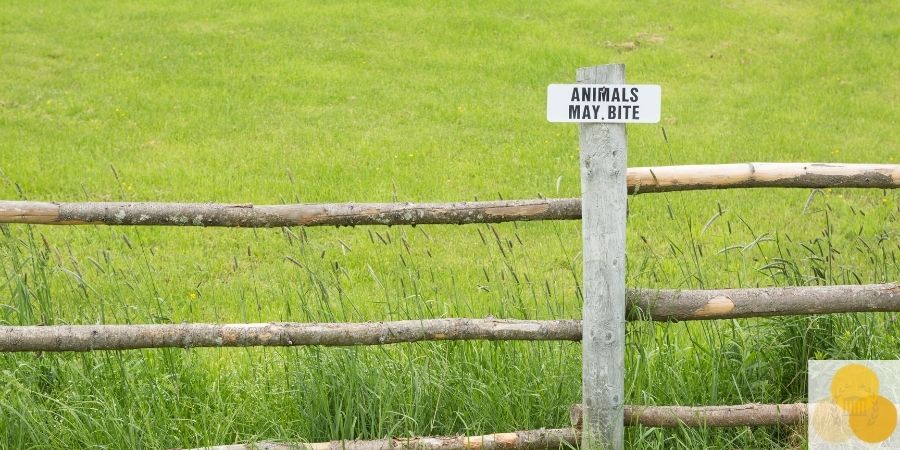
What if a cat, horse or other animal bit you?
Some dog-bite statutes cover only dogs, as Michigan’s and California’s do (MCL 287.351(1); Cal. Civ. Code § 3342(a)). Illinois’s covers “a dog or other animal” (510 ILCS 5/16). Where no statute applies, the common-law rules do, such as the one-bite rule, which often comes up with domesticated animals (LII), and negligence.
The medical risks differ by animal, too. “Cat bites are less common but have a higher risk for infection,” and cats’ longer, sharper teeth can cause deeper puncture wounds (MedlinePlus). Bats, skunks, raccoons and foxes are the animals most often found with rabies in the U.S. (CDC), and after a bite from a wild or stray animal, you should contact a provider right away (MedlinePlus).
How common are dog bite injuries and claims?
“Nearly 1 in 5 people bitten by a dog requires medical attention,” according to the CDC. Deaths are rare: from 2011 through 2021, 468 people in the U.S. died from being bitten or struck by a dog, an average of 43 a year, with the most, 81, in 2021 (CDC, National Vital Statistics System).
Insurance claims have risen. In 2025, homeowners insurers paid $1.86 billion on an estimated 28,450 dog-related injury claims, up from 22,658 claims in 2024. The average cost per claim was $65,450, down from $69,272 (Triple-I and State Farm). The figures include other dog-related injuries, such as fractures, and an average across very different injuries isn’t a prediction for any one claim.
Who pays for an animal bite claim?
Usually the owner’s insurance. Homeowners and renters policies typically cover dog-bite liability up to the policy’s liability limit, often $100,000 to $300,000, and the owner is responsible for damages above it (Triple-I). If the owner has no insurance, the claim is against the owner personally.
For umbrella policies, medical-payments coverage and what a claim can be worth, see how dog bite compensation works. If a health plan or Medicare paid your bills, read who gets paid from a settlement before you settle. If a dog attacked your pet, see who pays when a dog bites another dog.
Before you talk to the owner’s insurer, read what to say, and not say, to an insurance adjuster.
What can an animal bite claim include?
Michigan’s model jury instructions give a useful map. They list the reasonable expenses of necessary medical care, past and future (M Civ JI 50.05); lost earning capacity (50.06); physical pain and suffering, mental anguish, fright and shock, denial of social pleasure and enjoyments, and embarrassment, humiliation or mortification (50.02); and disability and disfigurement, which Michigan recognizes as separate kinds of damages (50.03). For how the non-economic parts are valued, see how pain and suffering is valued and proven.
Scarring and disfigurement
A bite can crush and tear tissue, and “deep or extensive wounds may result in significant scarring” (MedlinePlus). Photograph the wound as it heals, and before you settle, ask your doctor how the scar is likely to look and what treatment it may need. In Michigan, scars and disfigurement can be shown in person to a case evaluation panel, although no party may testify (MCR 2.403(J)(1)).
Children, fear and PTSD
Children are more likely than adults to be bitten, their injuries tend to be more severe, and most dog bites to young children happen during everyday activities, with familiar dogs (CDC). Compared with adults, children are much more likely to be bitten on the face, head or neck (MedlinePlus).
The fear can outlast the wound. In a small study published in 2004, 12 of 22 children who had been bitten by dogs had symptoms of post-traumatic stress disorder (PTSD) 2 to 9 months later, and violent attacks that caused multiple or deep wounds were associated with the risk (Peters and others, Journal of Pediatrics). Most people recover from their reactions to a traumatic event, but symptoms that last and begin to interfere with daily life can lead to a PTSD diagnosis (National Institute of Mental Health). If your child’s fear isn’t fading, tell the doctor and keep notes on what you see.
How long do you have to file an animal bite lawsuit?
Every state sets a deadline for filing an injury lawsuit, called a statute of limitations, and it can differ by the kind of claim. See injury filing deadlines in every state.
How does an animal bite claim become a lawsuit?
A claim can settle at any point. If it doesn’t, here is the path in Michigan; other states’ court rules differ in the details.
- The claim. You or your lawyer send the owner’s insurer your medical records, bills and proof of lost pay, with a demand. To settle, you sign a release, which is essentially a waiver of your right to sue (LII), so it generally ends the claim.
- The lawsuit. A complaint is filed in district court if the claim is for $25,000 or less (MCL 600.8301(1)), and otherwise in circuit court (MCL 600.605). Once the owner is served with the summons and complaint in Michigan, they generally have 21 days to answer (MCR 2.108(A)(1)).
- Discovery. Each side gathers evidence through written questions, requests for documents, such as the dog’s veterinary records, and depositions, which are questioning under oath (MCR 2.306, 2.309, 2.310). If your physical or mental condition is in controversy, the court may order an examination, on motion and for good cause (MCR 2.311(A)).
- Case evaluation. The court may send the case to a panel of three evaluators, who hear short presentations and put a value on it (MCR 2.403(A)(1), (D)(1), (J)(3), (K)). Each side has 28 days to accept or reject, and not answering counts as rejection (MCR 2.403(L)(1)). If everyone accepts, the case ends on those terms; if anyone rejects, it proceeds to trial (MCR 2.403(M)(1), (N)(1)).
- Mediation. A neutral mediator helps the two sides look for a settlement but has no power to decide the case (MCR 2.411(A)(2)).
- Trial or settlement. A case that doesn’t settle is decided at trial. In a filed case, a child’s settlement needs the judge’s approval (MCR 2.420).
For how long each stage can take, see how long an injury case takes.
What to do next
- Get the bite treated, keep every follow-up appointment, and ask about rabies and tetanus.
- Report the bite, and get the owner’s name, contact details and insurer, and the animal’s vaccination record.
- Build your record: photos as the wound heals, medical bills, missed work or school, and short notes on pain, sleep and fear, especially a child’s.
- Be careful with the insurer: don’t give a recorded statement or sign a release before you know how you’ve healed and have had advice.
- Get a free case review before your deadline gets close. Get a free case review, or if you were bitten in Michigan, compare Michigan dog bite lawyers. In Michigan, a contingency fee in an injury case can’t be more than one-third of the net recovery, and the agreement must be in writing (MCR 8.121(B), (C), (F)). See how injury lawyers get paid.
What waiting can cost
- Rabies protection. Care after a possible rabies exposure is urgent (CDC).
- Evidence. A healed wound can’t be photographed fresh, and witnesses forget.
- Your right to sue. In Michigan, most injury lawsuits must be filed within three years, and negotiating with an insurer generally doesn’t stop the clock (MCL 600.5805(2), 600.5856).
What a good outcome looks like
The bite is treated, the report is on file and your questions about rabies and scarring have answers. The owner’s insurer pays your medical bills, your lost pay and a fair amount for the pain, the scar and the fear, and if a child’s claim is in a lawsuit, the judge checks that the settlement is fair and the money is protected. From wondering whether anyone is responsible for an animal bite to knowing which rule applies, who pays and how long you have.
More help: how dog bite compensation works, who pays when a dog bites another dog, the complete premises liability guide and Michigan personal injury law in plain English.
Frequently asked questions
Is a dog owner automatically liable for a bite?
It depends on the state. Some states have a dog-bite statute that makes the owner liable for a bite without provocation, whatever the dog's history; others follow the one-bite rule, which requires proof that the owner knew or should have known the dog was likely to hurt people (Triple-I; Cornell LII). Michigan has a statute: the owner is liable if the dog bit without provocation while you were on public property or lawfully on private property, including the owner's (MCL 287.351(1)). You have to prove those facts and that the defendant owned the dog (M Civ JI 80.02).
What counts as provoking a dog?
In Michigan, provocation is 'any action or activity, whether intentional or unintentional, which would reasonably be expected to cause a dog in similar circumstances to react in a manner similar to that shown by the evidence' (M Civ JI 80.03). A jury found provocation when a woman accidentally stepped backward onto an elderly dog (Brans v Extrom, 2005). Bending down near an eating dog to pick up a dropped football was not provocation, because the bite was out of proportion to anything the 12-year-old did (Bradacs v Jiacobone, 2001).
Can a child who wandered into a neighbor's yard make a dog-bite claim?
It depends on whether the child had permission to be there, and permission can be implied. Michigan's statute covers people on private property as an invitee or licensee of whoever lawfully possesses it (MCL 287.351(2)). In one case, a 3-year-old bitten in a neighbor's yard, where she often came with the family's teenage daughter and children were never asked to leave, could be an implied licensee, and the Court of Appeals reversed a ruling against her (Cox v Hayes, 1971). A trespasser isn't lawfully on the property (M Civ JI 80.04).
Can you sue if a cat, horse or other animal bit you?
Possibly, but usually not under a dog-bite statute. Michigan's statute covers only dogs, so for other animals the common-law rules apply: an owner who knew or had reason to know of a domestic animal's abnormally dangerous tendencies is strictly liable for harm that results from them, and anyone in possession of an animal can be liable for negligence in controlling it (Trager v Thor, 1994). For horses, Michigan's Equine Activity Liability Act bars claims by riders and other participants for injuries resulting from the inherent risks of equine activities, except in listed situations, such as tack the provider knew or should have known was faulty, or negligence by someone who isn't a sponsor or equine professional (MCL 691.1663, 691.1665). Some states' statutes reach other animals: Illinois's covers a 'dog or other animal' (510 ILCS 5/16).
Can a landlord or someone watching the dog be held responsible?
Michigan's dog-bite statute makes only the dog's owner liable (Trager v Thor, 1994). A landlord who didn't own, keep or control a tenant's dog wasn't liable under the statute, and a common-law claim against him failed because he didn't know the dog was vicious (Szkodzinski v Griffin, 1988). Under the common law, someone who isn't the owner can be strictly liable as a keeper only with control over the animal akin to ownership. A grandfather watching his son's home and dog for an afternoon wasn't a keeper, but a negligence claim against him could go to trial because there was evidence he knew the dog had bitten a child before (Trager).
What if a dog bit you while you were working?
In Michigan, someone on the owner's property to perform a duty imposed by state law or by federal law or postal regulations, such as delivering mail, is lawfully there (MCL 287.351(2)). If workers' compensation pays for the injury, you can also pursue the dog's owner, unless the owner is your employer or a co-worker; what you recover from the owner first repays the comp benefits, after the costs of recovery (MCL 418.827(1), (5)). Elsewhere, the rules can differ for people who handle dogs for a living: California's Supreme Court held that a kennel worker couldn't recover under its dog-bite statute for a bite from a dog boarded where she worked (Priebe v. Nelson, 2006).
Sources
- MCL 287.351, Person bitten by dog; liability of owner · Michigan Legislature
- MCL 418.827, Workers' disability compensation act: third-party liability · Michigan Legislature
- MCL 600.605, Circuit court; original jurisdiction · Michigan Legislature
- MCL 600.2959, Comparative fault; reduced damages · Michigan Legislature
- MCL 600.5805, Injuries to persons or property; period of limitations · Michigan Legislature
- MCL 600.5851, Disabilities of infancy or insanity · Michigan Legislature
- MCL 600.5856, Tolling of statute of limitations or repose · Michigan Legislature
- MCL 600.8301, District court; exclusive jurisdiction in civil actions · Michigan Legislature
- MCL 691.1662, Equine activity liability act: definitions · Michigan Legislature
- MCL 691.1663, Equine activity liability act: no liability for inherent risks · Michigan Legislature
- MCL 691.1665, Equine activity liability act: exceptions · Michigan Legislature
- Michigan Administrative Code, R 325.180, Procedures for control of rabies (Communicable and Related Diseases rules) · Michigan Office of Administrative Hearings and Rules
- Michigan Model Civil Jury Instructions (updated July 21, 2026): chapter 80, Dog Bite Actions (M Civ JI 80.01-80.05), and M Civ JI 12.01, 50.02, 50.03, 50.05 and 50.06 · Michigan Supreme Court
- Michigan Court Rules (updated September 2, 2026): MCR 2.102, 2.108, 2.306, 2.309, 2.310, 2.311, 2.403, 2.411, 2.420 and 8.121 · Michigan Supreme Court
- Trager v Thor, 445 Mich 95 (1994) · Caselaw Access Project, Harvard Law School
- Hiner v Mojica, 271 Mich App 604 (2006) · Caselaw Access Project, Harvard Law School
- Hill v Sacka, 256 Mich App 443 (2003) · Caselaw Access Project, Harvard Law School
- Brans v Extrom, 266 Mich App 216 (2005)
- Tate v City of Grand Rapids, 256 Mich App 656 (2003)
- Koivisto v Davis, 277 Mich App 492 (2008) · Caselaw Access Project, Harvard Law School
- Bradacs v Jiacobone, 244 Mich App 263 (2001) · Caselaw Access Project, Harvard Law School
- Cox v Hayes, 34 Mich App 527 (1971) · Caselaw Access Project, Harvard Law School
- Szkodzinski v Griffin, 171 Mich App 711 (1988) · Caselaw Access Project, Harvard Law School
- Priebe v. Nelson, 39 Cal. 4th 1112 (2006) · Caselaw Access Project, Harvard Law School
- California Civil Code § 3342, Dog bites; liability of owner · California Legislative Information
- 510 ILCS 5/16, Animal attacks or injuries (Illinois Animal Control Act) · Illinois General Assembly
- Dogs (Healthy Pets, Healthy People), June 15, 2026 · Centers for Disease Control and Prevention
- QuickStats: Number of Deaths Resulting from Being Bitten or Struck by a Dog, by Sex, National Vital Statistics System, United States, 2011-2021 (MMWR, September 8, 2023) · Centers for Disease Control and Prevention
- About Rabies (January 27, 2026) · Centers for Disease Control and Prevention
- Animal bites - self-care (reviewed April 13, 2026) · MedlinePlus, U.S. National Library of Medicine
- Traumatic Events and Post-Traumatic Stress Disorder (PTSD) (last reviewed December 2024) · National Institute of Mental Health
- Peters V, Sottiaux M, Appelboom J, Kahn A. Posttraumatic stress disorder after dog bites in children. J Pediatr. 2004;144(1):121-2 · PubMed, U.S. National Library of Medicine
- Spotlight on: Dog bite liability (claims data 2016-2025) · Insurance Information Institute (Triple-I)
- Dog-Related Injury Claims on the Rise in 2025 (April 13, 2026) · Insurance Information Institute (Triple-I)
- One-bite rule (Wex legal dictionary) · Legal Information Institute, Cornell Law School
- Release (Wex legal dictionary) · Legal Information Institute, Cornell Law School
- Alabama: Ala. Code § 3-6-1, Liability of owner of dog for injuries to person bitten or injured while upon property owned or controlled by owner · Alabama Legislature (ALISON)
- Alabama: Ala. Code § 3-6-3, Mitigation of damages · Alabama Legislature (ALISON)
- Alabama: Humphries v. Rice, 600 So. 2d 975 (Ala. 1992) · Caselaw Access Project, Harvard Law School
- Alaska: Hale v. O'Neill, 492 P.2d 101 (Alaska 1971) · Caselaw Access Project, Harvard Law School
- Arizona: A.R.S. § 11-1025, Liability for dog bites; owner information; military and police work; definitions · Arizona State Legislature
- Arizona: A.R.S. § 11-1020, Dogs; liability · Arizona State Legislature
- Arizona: A.R.S. § 11-1027, Reasonable provocation as defense · Arizona State Legislature
- Arkansas: Hamby v. Haskins, 275 Ark. 385, 630 S.W.2d 37 (1982) · Caselaw Access Project, Harvard Law School
- Colorado: C.R.S. § 13-21-124, Civil actions against dog owners, as enacted by 2004 Colo. Sess. Laws ch. 168 (H.B. 04-1279); unamended through C.R.S. 2026 · Colorado General Assembly
- Connecticut: Conn. Gen. Stat. § 22-357, Damage by dogs to person or property · Connecticut General Assembly
- Delaware: 16 Del. C. § 3053F, Liability of dog owner for damages · Delaware General Assembly
- District of Columbia: Karlow v. Fitzgerald, 288 F.2d 411 (D.C. Cir. 1961) · Caselaw Access Project, Harvard Law School
- District of Columbia: D.C. Code § 8-1808, Prohibited conduct (dogs at large) · Council of the District of Columbia
- Florida: Fla. Stat. § 767.04, Dog owner's liability for damages to persons bitten (2026) · Florida Legislature
- Florida: Fla. Stat. § 767.01, Dog owner's liability for damages to persons, domestic animals, or livestock (2026) · Florida Legislature
- Georgia: S&S Towing & Recovery, Ltd. v. Charnota, 309 Ga. 117 (2020) (quoting O.C.G.A. § 51-2-7) · Supreme Court of Georgia
- Georgia: Steagald v. Eason, 300 Ga. 717 (2017) · Caselaw Access Project, Harvard Law School
- Hawaii: HRS § 663-9, Liability of animal owners · Hawaii State Legislature
- Hawaii: HRS § 663-9.1, Exception of animal owners to civil liability · Hawaii State Legislature
- Hawaii: Franks v. Holloway, No. CAAP-18-0000427 (Haw. Ct. App. Nov. 28, 2023) · Hawaii State Judiciary
- Idaho: Idaho Code § 25-2810, Dangerous and at-risk dogs · Idaho Legislature
- Idaho: Boswell v. Steele, 428 P.3d 218 (Idaho 2018) · Caselaw Access Project, Harvard Law School
- Indiana: IC 15-20-1-3, Dog bite liability (2026 Indiana Code, Title 15, Article 20, Chapter 1) · Indiana General Assembly
- Indiana: Poznanski ex rel. Poznanski v. Horvath, 788 N.E.2d 1255 (Ind. 2003) · Caselaw Access Project, Harvard Law School
- Iowa: Iowa Code § 351.28, Liability for damages (Iowa Code 2026) · Iowa Legislature
- Kansas: Berry ex rel. Berry v. Kegans, 196 Kan. 388 (1966) · Caselaw Access Project, Harvard Law School
- Kentucky: KRS 258.235, Authority to kill or seize dog; liability for damage; vicious dogs · Kentucky General Assembly
- Kentucky: Benningfield ex rel. Benningfield v. Zinsmeister, 367 S.W.3d 561 (Ky. 2012) · Caselaw Access Project, Harvard Law School
- Louisiana: Civil Code art. 2321, Damage caused by animals; livestock · Louisiana State Legislature
- Louisiana: Pepper v. Triplet, 864 So. 2d 181 (La. 2004) · Caselaw Access Project, Harvard Law School
- Maine: 7 M.R.S. § 3961, Reimbursement for damage done by animals · Maine Legislature
- Maryland: Md. Code, Cts. & Jud. Proc. § 3-1901 (liability of dog owners for injuries caused by their dogs) · Maryland General Assembly
- Massachusetts: M.G.L. c. 140, § 155, Liability for damage caused by dog; minors; presumption and burden of proof · Massachusetts Legislature
- Minnesota: Minn. Stat. § 347.22, Damages, owner liable · Minnesota Office of the Revisor of Statutes
- Mississippi: Poy v. Grayson, 273 So. 2d 491 (Miss. 1973) · Caselaw Access Project, Harvard Law School
- Mississippi: TLM Investments, LLC v. Yates, No. 2024-IA-00204-SCT (Miss. May 8, 2025) · Supreme Court of Mississippi
- Missouri: Mo. Rev. Stat. § 273.036, Owner liable, when; fine, amount · Missouri Revisor of Statutes
- Montana: Mont. Code Ann. § 27-1-715, Liability of owner of vicious dog (2025) · Montana Legislature
- Montana: Stroop v. Day, 271 Mont. 314 (1995) · Caselaw Access Project, Harvard Law School
- Nebraska: Neb. Rev. Stat. § 54-601, Dogs; personal property; owner liable for damages; exceptions · Nebraska Legislature
- Nebraska: Paulsen v. Courtney, 202 Neb. 791 (1979) · Caselaw Access Project, Harvard Law School
- Nevada: NRS 202.500, Dangerous or vicious dogs: Unlawful acts; penalties (criminal; Nevada has no civil dog-bite statute) · Nevada Legislature
- New Hampshire: RSA 466:19, Liability of owner or keeper · New Hampshire General Court
- New Jersey: N.J.S.A. 4:19-16, Liability of owner regardless of viciousness of dog · New Jersey Legislature
- New Mexico: Perkins v. Drury, 57 N.M. 269 (1953) · Caselaw Access Project, Harvard Law School
- New Mexico: Smith ex rel. Smith v. Village of Ruidoso, 1999-NMCA-151, 128 N.M. 470 · Caselaw Access Project, Harvard Law School
- New York: Collier v. Zambito, 1 N.Y.3d 444 (2004) · Caselaw Access Project, Harvard Law School
- New York: Flanders v. Goodfellow, 2025 NY Slip Op 02261 (N.Y. Apr. 17, 2025) · New York Court of Appeals slip opinion (New York State Law Reporting Bureau), via CourtListener, Free Law Project
- New York: Agriculture and Markets Law § 123, Dangerous dogs · New York State Senate
- North Carolina: N.C. Gen. Stat. § 67-4.4, Strict liability · North Carolina General Assembly
- North Carolina: N.C. Gen. Stat. § 67-4.1, Definitions and procedures (dangerous dogs) · North Carolina General Assembly
- North Carolina: N.C. Gen. Stat. § 67-12, Permitting dogs to run at large at night; penalty; liability for damage · North Carolina General Assembly
- North Carolina: Holcomb v. Colonial Associates, L.L.C., 358 N.C. 501 (2004) · Caselaw Access Project, Harvard Law School
- North Dakota: Sendelbach v. Grad, 246 N.W.2d 496 (N.D. 1976) · Caselaw Access Project, Harvard Law School
- North Dakota: O'Leary v. Coenen, 251 N.W.2d 746 (N.D. 1977) · Caselaw Access Project, Harvard Law School
- Ohio: Ohio Rev. Code § 955.28, Dog may be killed for certain acts; owner liable for damages · Ohio Legislative Service Commission
- Oklahoma: Okla. Stat. tit. 4, §§ 42.1-42.3, Personal injury by dog (Title 4, complete title, page 20) · Oklahoma Legislature
- Oklahoma: Nickell v. Sumner, 1997 OK 101, 943 P.2d 625 · Caselaw Access Project, Harvard Law School
- Oregon: ORS 31.360, Proof required for claim of economic damages in action arising from injury caused by dog; ORS 31.705 (ORS chapter 31) · Oregon State Legislature
- Oregon: Westberry v. Blackwell, 282 Or. 129 (1978) · Caselaw Access Project, Harvard Law School
- Pennsylvania: Dog Law, Act of Dec. 7, 1982, P.L. 784, No. 225, § 502 (3 P.S. § 459-502) · Pennsylvania General Assembly
- Pennsylvania: Underwood ex rel. Underwood v. Wind, 954 A.2d 1199 (Pa. Super. Ct. 2008) · Caselaw Access Project, Harvard Law School
- Rhode Island: R.I. Gen. Laws § 4-13-16, Action for damages to animals; double damages on second recovery; destruction of offending dog · Rhode Island General Assembly
- Rhode Island: Wilbur v. Gross, 55 R.I. 473 (1936) · Caselaw Access Project, Harvard Law School
- South Carolina: S.C. Code § 47-3-110, Liability for attacks by dogs, provoked attacks, trained law enforcement dogs (Title 47, Chapter 3) · South Carolina Legislature
- South Dakota: Gehrts v. Batteen, 2001 SD 10, 620 N.W.2d 775 · Caselaw Access Project, Harvard Law School
- Tennessee: Tenn. Code Ann. § 44-8-413, Civil liability for injury caused by dogs, as enacted by 2007 Tenn. Pub. Acts ch. 276 (Dianna Acklen Act of 2007) · Tennessee Secretary of State
- Tennessee: 2016 Tenn. Pub. Acts ch. 662, amending Tenn. Code Ann. § 44-8-413(e)(1) (definition of owner) · Tennessee Secretary of State
- Tennessee: Folad v. Quillco, LLC, No. M2020-00628-COA-R3-CV (Tenn. Ct. App. Dec. 15, 2020) (quoting Tenn. Code Ann. § 44-8-413) · Court of Appeals of Tennessee, via CourtListener, Free Law Project
- Texas: Marshall v. Ranne, 511 S.W.2d 255 (Tex. 1974) · Caselaw Access Project, Harvard Law School
- Texas: Bushnell v. Mott, 254 S.W.3d 451 (Tex. 2008) · Caselaw Access Project, Harvard Law School
- Utah: Utah Code § 18-1-1, Liability and damages for dog injury; exceptions (effective May 7, 2025) · Utah State Legislature
- Vermont: Martin ex rel. Martin v. Christman, 2014 VT 55, 196 Vt. 536 · Caselaw Access Project, Harvard Law School
- Virginia: Butler v. Frieden, 208 Va. 352 (1967) · Caselaw Access Project, Harvard Law School
- Virginia: Model Jury Instructions, Civil, Release 26 (April 2026), Instruction No. 29.020, Dog owner's duty: no leash ordinance · Virginia's Judicial System
- Washington: RCW 16.08.040, Dog bites; liability; RCW 16.08.050; RCW 16.08.060 (chapter 16.08) · Washington State Legislature
- West Virginia: W. Va. Code § 19-20-13, Dog running at large; liability of owner · West Virginia Legislature
- West Virginia: Marcum v. Bellomy, 157 W. Va. 636 (1974) · Caselaw Access Project, Harvard Law School
- West Virginia: Jividen v. Law, 194 W. Va. 705 (1995) · Caselaw Access Project, Harvard Law School
- Wisconsin: Wis. Stat. § 174.02, Owner's liability for damage caused by dog; penalties; court order to kill a dog · Wisconsin State Legislature
- Wyoming: Borns ex rel. Gannon v. Voss, 2003 WY 74, 70 P.3d 262 · Caselaw Access Project, Harvard Law School
- Walter v City of Flint, 40 Mich App 613 (1972) · Michigan Court of Appeals, via the Caselaw Access Project (Harvard Law School)
Updated September 28, 2026
This guide is general information, not legal advice, and laws change. For advice about your situation, talk to a lawyer licensed in your state. Reading this page or contacting us does not create an attorney-client relationship.