
You were backing out of a space, walking to your car or waiting for a spot when another vehicle hit you. Now you’re hurt, and the other driver says it was your fault. If you’re shaken and not sure how fault works off the road, that’s normal.
Here’s the plain answer. Fault in a parking lot or garage turns on negligence: who failed to use the care a reasonably careful person would have used in that spot. Blame can be shared, including with the lot’s owner if a hazard it should have fixed helped cause the crash. In Michigan, most rules of the road are written for public roads, so a jury weighs the lot’s signs, layout and circumstances instead. Michigan’s rules are in the boxes marked “In Michigan.”
The hard part is usually the proof: police may not file the usual crash report for a crash inside a lot, and the other driver’s insurer may say you were just as much to blame.
Hurt in a parking lot and not sure where you stand? Get a free case review. Four quick questions, no cost, no obligation.
How is fault decided in a parking lot?
Most parking lot claims are negligence claims: someone failed to use the care a reasonable person would use in the same circumstances (Cornell Law School’s Legal Information Institute, or Cornell LII). Michigan’s model jury instruction tells jurors that the law doesn’t spell out what a careful person would do: “That is for you to decide” (M Civ JI 10.02). In a lot, that means weighing the lanes, arrows and stop signs, what each person could see, speed, and who was moving first.
What if you were partly at fault?
In most states, being partly at fault reduces what you recover instead of ending the claim, though most of them cut off recovery once your share reaches 50% or 51%. A few places still follow contributory negligence, which can bar recovery for any fault at all (Cornell LII). See each state’s shared-fault rule.
Who is at fault in common parking lot crashes?
These examples are made up; the percentages only show the math.
Backing out of a space
A driver backing out is moving into a lane others are using, so the questions are whether they looked, went slowly and stopped when someone appeared. A driver in the lane who was speeding or not watching can share the blame. This isn’t a rear-end crash, where one car runs into the back of another going the same way: the backing car’s rear strikes a car or person crossing behind it.
A made-up example: Dana backs out of a grocery store space as Lee drives down the lane a little fast, and Dana’s bumper hits Lee’s door. If a jury finds Dana 75% at fault and Lee 25%, in most states Lee’s damages are cut by 25%, and in Michigan, Dana gets no pain-and-suffering or mini-tort damages from Lee.
Pulling out of a space
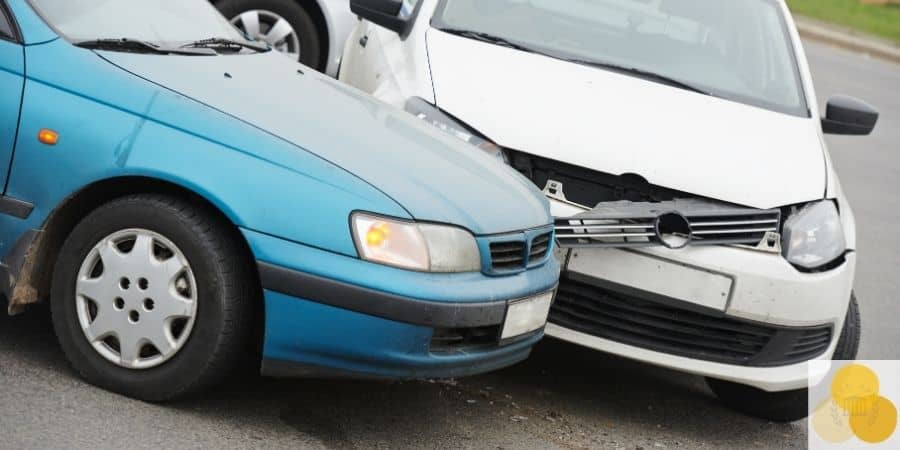
When a driver pulls forward out of a space, or out of a row into a main lane, the questions are whether they waited for a safe gap, and whether the approaching driver was speeding or looking at a phone. These crashes can end in a side-impact (T-bone) collision.
Through lanes and feeder lanes
Many lots have main lanes along the edges and toward the exits, sometimes called through lanes, and narrower feeder lanes between the rows. You may read that feeder-lane traffic must always yield to the through lane, but Michigan’s right-of-way rules are written for public roads (MCL 257.601). A jury looks instead at the lot’s own signs and arrows, who reached the crossing first, and each driver’s speed and view. In one Michigan case, the other driver said snow had hidden a stop sign where two lanes met in a shopping center’s lot (Pustay v Gentelia, below).
Two cars backing out at once
Each driver was moving and should have looked behind, so a jury can split the fault, even evenly.
A made-up example: Two drivers back out of facing spaces in a parking garage and collide, and a jury finds each 50% at fault. In Michigan, 50% isn’t “more than 50%,” so each recovers half of their damages from the other, including pain and suffering if the injury meets the legal threshold and a mini-tort claim for car damage insurance doesn’t cover (MCL 600.2959; 500.3135(2)(b), (4)(a)). In a state that bars recovery at 50%, neither would recover (Cornell LII).
Pedestrians
A driver must use ordinary care for others’ safety, and a pedestrian for their own (in Michigan, M Civ JI 10.04, 10.05). Was the driver watching and slow enough to stop? Did the pedestrian look before stepping into the lane? A pedestrian’s own share of fault can reduce what they recover.
The National Highway Traffic Safety Administration (NHTSA) estimates that in 2021, 64,838 people were injured in crashes off public roads, including crashes in parking facilities and driveways. About 30% were people outside a vehicle, such as pedestrians, and 37% of those were hit by a vehicle backing up.
What should you do after a parking lot accident?
Evidence in a lot disappears quickly: cars move, shoppers leave and video gets recorded over.
- Get safe, and call 911 if anyone is hurt.
- Swap information: names, addresses, license, plate and insurance details, and the owner’s name if the driver doesn’t own the car.
- Photograph the scene, if it’s safe: where the cars stopped, the damage, arrows, stop signs, lighting, potholes and anything that blocked a view.
- Find the cameras, and ask the store or property manager in writing, right away, to save the footage. See how to preserve crash evidence.
- Get witnesses’ names and phone numbers.
- Be careful with the other driver’s insurer. You don’t have to give it a recorded statement, and it’s safer not to before you’ve had advice; see talking to an insurance adjuster.
If the other driver left, see what to do after a hit-and-run. For the days ahead, keep our checklist of 10 things to do after a car accident handy.
When can the parking lot owner share the blame?
Whoever controls the lot, such as a store, landlord or property manager, can share the blame if it failed to use reasonable care about a dangerous condition it knew about, or should have found, and that condition helped cause your injury. This is called premises liability. Think of a stop sign hidden by piled snow, a deep pothole or open trench, a blind corner, or lighting too dim to show a hazard. A contractor that created the hazard can face an ordinary negligence claim too (in Michigan, Bowerman v Red Oak Management Co, 2026).
If you were attacked in a lot, the claim is about security. A Michigan business must respond reasonably to situations on its property that “pose a risk of imminent and foreseeable harm to identifiable invitees,” a duty “limited to reasonably expediting the involvement of the police,” and it doesn’t have to hire guards (MacDonald v PKT, Inc, 2001); see negligent security claims. A government agency that runs a lot may be immune from injury claims unless an exception applies (MCL 691.1407(1)); see claims involving government property.
Not sure whether the lot's owner shares the blame? Get a free case review. Four quick questions, no cost, no obligation.
Who pays after a parking lot accident?
That depends on whether your state is an at-fault or a no-fault state; our car accident lawsuit guide explains both.
What to do next
- Get medical care, and describe every symptom.
- Save the evidence now: photos, witness names and a written request to the lot’s owner or manager to keep its video.
- Mark your deadlines. In Michigan: written PIP notice within one year (MCL 500.3145(1)), and a lawsuit against the other driver or the lot’s owner generally within three years (MCL 600.5805(2)).
- Don’t guess about fault with the other driver’s insurer, and don’t sign a release before you know how badly you’re hurt.
- Get a free case review before the deadlines get close. Tell us what happened, or compare Michigan injury lawyers.
What waiting can cost
- The video. Cameras can record over footage before anyone asks for it.
- Your PIP benefits. In Michigan, without written notice or a payment within a year, you can lose the right to sue for them (MCL 500.3145(1)).
- A parked-car claim. A lawsuit for property protection benefits must start within one year of the crash (MCL 500.3145(5)).
What a good outcome looks like
The fault split matches the evidence, not the other driver’s first story or an adjuster’s guess. Your medical bills and lost pay are covered while you heal, your car is fixed, and if the lot’s owner let a hazard help cause the crash, it answers for its share. From wondering who’s to blame for a crash in a parking lot to knowing what the evidence shows, who pays and which deadlines apply to you.
For more, browse our car, truck and motorcycle accident guides. Hurt in Michigan? Start with Michigan injury law in plain English.
Frequently asked questions
Who is at fault in a parking lot accident?
Whoever failed to use ordinary care, meaning the care a reasonably careful person would have used in the same circumstances (M Civ JI 10.02). That can be the driver backing out, a driver speeding down the lane, a pedestrian who didn't look, or more than one of them. In most states, fault is split by percentage and your share reduces what you recover (Cornell LII); Michigan follows that rule (MCL 600.2959).
Do Michigan traffic laws apply in a parking lot?
Most rules of the road don't. They 'refer exclusively to the operation of vehicles upon highways except where a different place is specifically referred to' (MCL 257.601), and a lot's owner may set its own rules (MCL 257.607). Some laws do name parking areas: drunk, reckless and careless driving are prohibited there (MCL 257.625(1), 257.626(2), 257.626b), and drivers in a crash on private property open to the public must stop and exchange information (MCL 257.617a, 257.618, 257.619).
Will the police write a report for a parking lot accident in Michigan?
Not necessarily the usual one. The Michigan State Police treat parking lots as non-traffic areas, and a crash that begins and ends in one doesn't have to be reported on the state's UD-10 crash report unless someone died. Non-traffic crashes also aren't posted to driving records (Michigan State Police). Call 911 if anyone is hurt, and gather your own evidence either way.
Who is at fault when two cars back into each other?
It can be both drivers, because each was moving and each should have looked behind, and a jury decides the split. In Michigan, a driver found exactly 50% at fault still recovers half of their damages, including pain and suffering if the injury meets the legal threshold and a mini-tort claim for car damage insurance doesn't cover. Above 50%, pain-and-suffering and mini-tort damages are barred (MCL 600.2959; 500.3135(2)(b), (4)(a)).
Can I sue the owner of the parking lot?
Sometimes, if a dangerous condition the owner knew about or should have found helped cause your injury, such as a hidden stop sign, an open trench or a deep pothole. In Michigan, a customer is an invitee, owed inspection and repairs or warnings (Stitt v Holland Abundant Life Fellowship, 2000), and an obvious hazard bears on the owner's breach and your share of fault rather than automatically ending the claim (Kandil-Elsayed v F & E Oil, 2023). Most such lawsuits must be filed within three years (MCL 600.5805(2)).
Does Michigan no-fault insurance cover a parking lot accident?
Yes. PIP covers injuries arising out of the use of a motor vehicle as a motor vehicle, and the statute doesn't limit that to public roads (MCL 500.3105(1)). Your own household's policy usually pays, even if you were on foot (MCL 500.3114(1), 500.3115). If only a parked vehicle was involved, PIP applies in narrow cases, such as getting into or out of it (MCL 500.3106(1)). If your properly parked car was hit, the other vehicle's property protection insurance pays for the damage (MCL 500.3123(1)(a); DIFS).
Sources
- Michigan Model Civil Jury Instructions (updated July 21, 2026): M Civ JI 10.02, 10.04 and 10.05, and Chapter 36, Introductory Directions to the Court · Michigan Supreme Court
- MCL 257.601, Applicability of chapter to operations on highways · Michigan Legislature
- MCL 257.20, "Highway or street" defined · Michigan Legislature
- MCL 257.607, Realty owners' regulation of traffic on private property · Michigan Legislature
- MCL 257.70, "Traffic control devices" defined · Michigan Legislature
- MCL 257.617a, Accident with personal injury; stopping required · Michigan Legislature
- MCL 257.618, Accident with damage to a vehicle; stopping required · Michigan Legislature
- MCL 257.619, Duties of a driver after an accident · Michigan Legislature
- MCL 257.620, Collision with an attended or unattended vehicle · Michigan Legislature
- MCL 257.625, Operating while intoxicated · Michigan Legislature
- MCL 257.626, Reckless driving · Michigan Legislature
- MCL 257.626b, Careless or negligent driving · Michigan Legislature
- Traffic Crash Advisory #5: Traffic Crash vs. Non-Traffic Crashes (February 2019) · Michigan State Police
- UD-10 Traffic Crash Report 2022 Instruction Manual · Michigan State Police
- Non-Traffic Surveillance: Fatality and Injury Statistics in Non-Traffic Crashes in 2021 (DOT HS 813 539, April 2024) · National Highway Traffic Safety Administration
- Pustay v Gentelia, 104 Mich App 250 (1981) · Michigan Court of Appeals, via the Caselaw Access Project, Harvard Law School
- Stitt v Holland Abundant Life Fellowship, 462 Mich 591 (2000) · Michigan Supreme Court, via the Caselaw Access Project, Harvard Law School
- Kandil-Elsayed v F & E Oil, Inc; Pinsky v Kroger Co of Mich, 512 Mich 95 (decided July 28, 2023) · Michigan Supreme Court
- Molitoris v Saint Mary Magdalen Catholic Church, No. 166699, order granting leave to appeal (May 22, 2026) · Michigan Supreme Court
- Bowerman v Red Oak Management Co, Inc (Docket No. 167718, decided July 20, 2026) · Michigan Supreme Court
- MacDonald v PKT, Inc, 464 Mich 322 (2001) · Michigan Supreme Court, via the Caselaw Access Project, Harvard Law School
- MCL 691.1407, Governmental immunity from tort liability · Michigan Legislature
- MCL 500.3105, PIP benefits payable without regard to fault · Michigan Legislature
- MCL 500.3106, Injuries involving parked vehicles · Michigan Legislature
- MCL 500.3107, Allowable expenses, work loss and replacement services · Michigan Legislature
- MCL 500.3107c, PIP medical coverage levels · Michigan Legislature
- MCL 500.3114, Which insurer pays PIP benefits (order of priority) · Michigan Legislature
- MCL 500.3115, PIP claims by people who were not in a vehicle · Michigan Legislature
- MCL 500.3121, Property protection insurance benefits · Michigan Legislature
- MCL 500.3123, Property excluded from property protection insurance; parked vehicles · Michigan Legislature
- MCL 500.3135, Tort liability, serious impairment of body function and the mini-tort · Michigan Legislature
- MCL 500.3145, Limitations on actions for PIP and property protection benefits; notice of injury · Michigan Legislature
- MCL 600.2959, Comparative fault; reduced damages · Michigan Legislature
- MCL 600.6304, Percentages of fault; several liability · Michigan Legislature
- MCL 600.5805, Period of limitations for injuries to persons or property · Michigan Legislature
- Auto insurance frequently asked questions (property protection; mini-tort) · Michigan Department of Insurance and Financial Services
- Negligence (Wex legal dictionary) · Legal Information Institute, Cornell Law School
- Comparative negligence (Wex legal dictionary) · Legal Information Institute, Cornell Law School
Updated September 28, 2026
This guide is general information, not legal advice, and laws change. For advice about your situation, talk to a lawyer licensed in your state. Reading this page or contacting us does not create an attorney-client relationship.